
The Hortensia Herrero Art Centre will host, starting April 29, a temporary exhibition by German artist Anselm Kiefer, one of the most influential figures in international contemporary art. Conceived in close collaboration with the artist himself, this marks Kiefer’s first exhibition in Valencia.
Curated by Javier Molins, the exhibition spans six galleries of the center, which have been adapted to accommodate the artist’s monumental and material language. “When we visited Kiefer in his studio in Croissy, I was amazed because he had recreated the galleries of this center at full scale with the ideal selection of works,” notes Hortensia Herrero regarding the exhibition’s design process. The layout offers an almost immersive experience that transcends a traditional exhibition, becoming an intervention on an architectural scale where history, landscape, and mythology intertwine.
The relationship between Hortensia Herrero and the artist dates back a decade, when the collector acquired her first work, Böse Blumen. This bond, strengthened over time, has made it possible to bring this exhibition to Valencia. “The first time I saw Anselm Kiefer’s work, with that strength, it captivated me. His art has something that makes you feel, focus, and immerse yourself in the work,” says Hortensia Herrero.
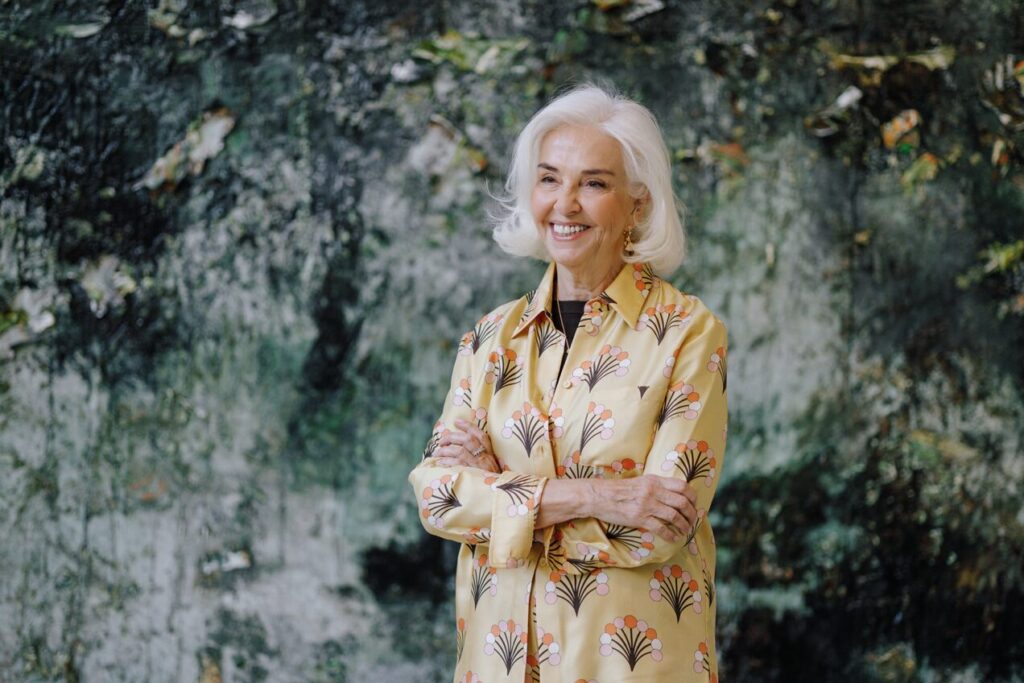
In this sense, Kiefer’s work naturally dialogues with the building that houses it—a space also shaped by layers of time, memory, and culture, reinforcing the reading of his pieces. “The truth is that if someone has never seen a work by Kiefer, they are very fortunate, because they will experience for the first time the incredible sensation of contemplating those works full of layers—the material, the texture, the colors—that, once seen, are never forgotten,” says Javier Molins, artistic director of the CAHH.
History, Landscape, and Mythology
The works by Kiefer in the Hortensia Herrero collection, displayed in the noble hall of the former palace—Böse Blumen, Walhalla, and Der Tod und das Mädchen—form the foundation upon which this exhibition has been developed. It seeks to explore themes such as history, as well as literature, nature, music, and mythology.
Among the works—many of which are leaving the artist’s studio for the first time—are Elektra, Dryad, and Danaë, referencing Greek myths. Other works such as Böse Blumen, Für Walther von der Vogelweide, and Wer jetzt keines Haus hat, baut sich keines mehr are inspired by poetry, specifically by Baudelaire, Walther von der Vogelweide, and Rilke. In the case of Der Tod und das Mädchen, music—particularly that of Schubert—is the source of inspiration.
Visitors can also enjoy one of his vitrines, Johannis Nacht, containing ferns, as well as Himmel–Erde (1974), the oldest piece by Kiefer included in the exhibition, among other works.
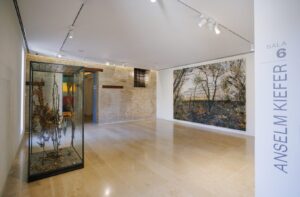
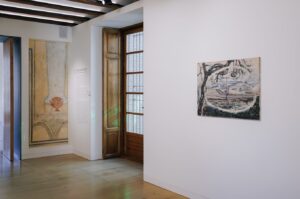
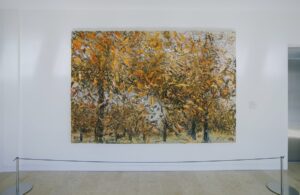
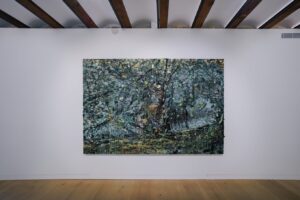
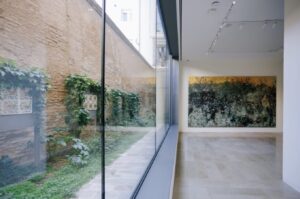
Danaë, a Monumental Work Shown for the First Time in Europe
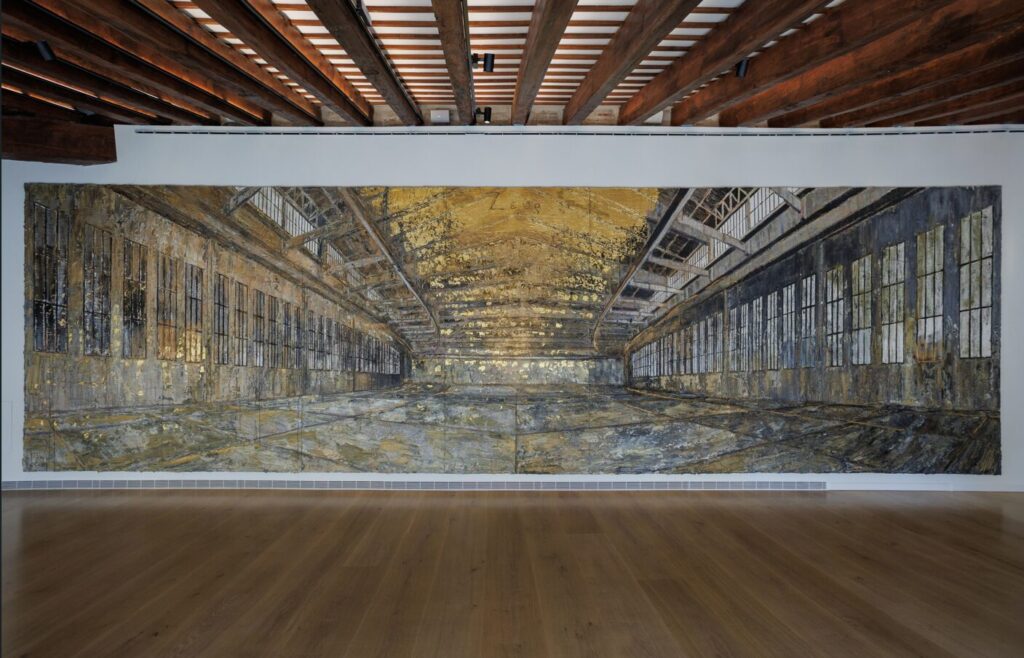
Among the highlights is Danaë, one of the largest works created by the artist to date—over thirteen meters wide—which will be shown in Europe for the first time.
In this work, Kiefer depicts the interior of Tempelhof Airport in Berlin while simultaneously referencing the myth of Danaë through a golden rain falling across the painting. According to Greek mythology, Zeus transformed himself into a shower of gold to visit and impregnate Danaë, who had been confined in a tower to prevent her from bearing children. This work has only been exhibited once before, in New York in 2022, and can now be seen for the first time in Europe.
About Anselm Kiefer
Anselm Kiefer was born in 1945 in Donaueschingen, Germany. In 1992, he moved to France, where he lives and works between Paris and Barjac, near Avignon. The artist studied Law, Literature, and Linguistics before enrolling at the Academy of Fine Arts in Karlsruhe and later in Düsseldorf, where he was a student of Joseph Beuys.
In 1980, he was selected to represent the West German Pavilion at the 39th Venice Biennale, and since then his works have been presented in major international solo exhibitions at prestigious institutions such as the Art Institute of Chicago (1987); the Nationalgalerie in Berlin (1991); the Metropolitan Museum of Art in New York (1998); the Fondation Beyeler in Basel (2001); the Guggenheim Museum Bilbao (2007); the Royal Academy of Arts in London (2014); the Centre Pompidou in Paris (2015); the Bibliothèque Nationale de France (2015); the Albertina in Vienna (2016); the State Hermitage Museum in St. Petersburg (2017); the Musée Rodin in Paris (2017); and the Met Breuer in New York (2018), among many others.
Kiefer received the Praemium Imperiale Award from Japan in 1999, and in 2008 he was awarded the Peace Prize of the German Book Trade. In 2007, he became the first artist since Georges Braque to receive a commission for a permanent installation at the Louvre Museum in Paris, and in 2018 his site-specific sculpture Uraeus was displayed in front of Rockefeller Center in New York. In 2020, French President Emmanuel Macron commissioned Anselm Kiefer to create a permanent installation for the Panthéon in Paris.